Saris And Other Indian Garments
The Sari
By the time that European countries came in contact was already wearing the sari as one of its main garments. The sari ranged in terms of its style and even color (access of an area's dyes and embroidery technique) from region to region, being a huge part of women's lives from North India to Deccan (Central India) to South India.
Other than the single use of pleating the sari around the hips and tossing it over the torso , many sari's would have an extra garment called Choli underneath it. Choli comes from from "Cholka" - a garment found in Gupta Empire which was worn like a crop top . The Cholka would have many descendants, including the choli and the kanchari (Alkazi 1983) --which is used by Parsi women underneath their saris as shown earlier in the exhibit
Choli would be adapted as an important part of the sari in Northen and Central India (Biswas 1985) , however, for many Southern states, incorporation of undergarments or a breast plate would only come from AFTER the British's imposition of modesty during their colonial rule. Specifically, the incorporation of the Blouse -- a similar garment to choli but with different name and style would be because of Mrs.Tagore and Bollywood appeal in the 20th century.
Other Garments
Along with the sari was 2 other commonplace garments, with the sari being used most widely across India.
The lengha-choli or gagri-choli : lengha and gagri signifying the same bottom garment of a skirt, and choli being a short top to accompany the ensemble. The lengha or gagri styling can be found in statues of Ancient India as a form of the antariya.
Worn in NorthEast states of Rajasthan as the traditional dress across class and caste. A third piece called a dupatta is used to cover the torso region and ends off toward the hips meeting the skirt every so slightly - reminiscent of the uttariya and its introduction as a stole.
Salwaar Kameez : Salwaar meaning bottoms which are usually trousers/pants nad kameez meaning top which is a long shirt that starts goes to the knees. This is worn in the states of Punjab, Haryana and country of Pakistan. Dupatta is used in this ensemble as to cover the head like a scarf or worn shoulder to shoulder like a necklace. The kameez 's influence is most heavily due to the introduction of Cental Asian attire through the Muslim Sultanate rule during from the 10th to 15th century CE which emphasized full coverage (Biswas, 1985).
While the sari is the focus of this exhibit, I wanted to highlight the other dress and costumes worn by Indian women which pop up in this exhibit along with the styles of sari in paintings, drawings and photographs.
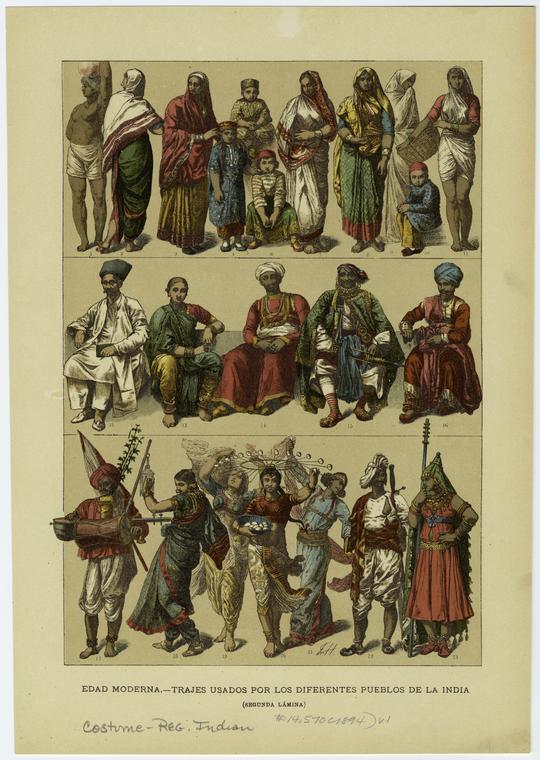
- The Parsi Sari can be seen in the first row with the women in Red with children standing next to the women in yellow. They both are wearing Gara style sari as seen on the ends of the sari through a thin line of Gara embroidery.
- The Koli Sari can be seen towards the end of the first row wearing a white sari and red choli .
- The Nauvrani sari is found in the second row with the second women in red, green and yellow. Signature nose rings signifies the Marathi regional style.
- Gharga-choli is seen on the women in the red in the last row specifically styled in Rajasthan fashion .
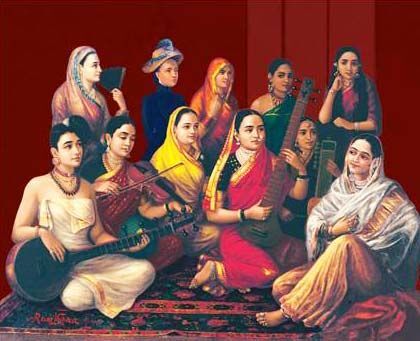
- Kerala Mundu sari shown in the women in the left corner first row. She is sporting the regional white color sari with its sides covered in golden embroidery and her jewelry and hairstyle to match the look.
- The women in the first row all the way to right is sporting a form of salwaar kameez as evidented by her trouser-like bottom and use of "dupatta".
- Women holding a sitar in red sari and green blouse with the end tail of the sari covering her head is most likely wearing the Nivi style sari although without looking a complete picture of her bottom, could be a Nauvrani sari as the famous Marathi noser ing is being worn by the musician.