
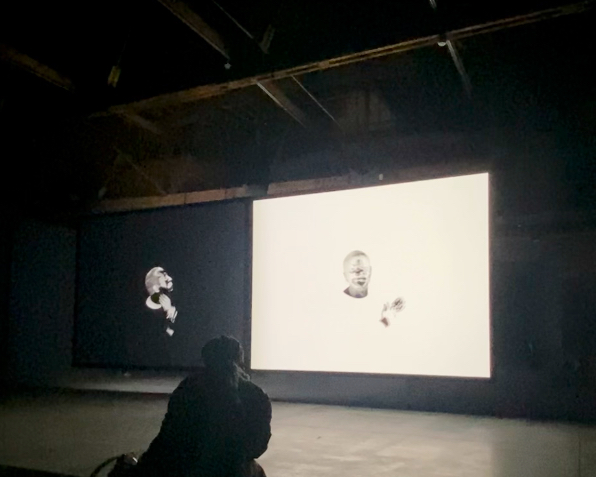
Last week, our class (Archaeology of Media: Film, Fashion, Montage) visited the new Steve McQueen exhibit at Dia Chelsea. It was an incredibly moving experience. The chief curator, Donna de Salvo, told us that as McQueen reflected on the installation, he remarked that it felt like the end of a chapter. As the semester comes to a close, chapter endings are on my mind, too.
In Sunshine State, McQueen shares a story his dad told him at the end of his life. McQueen had never heard the story before. Something happened to his dad when he lived in Florida. McQueen realized that this event shaped the way that his father raised him. McQueen repeats the story again and again, but each time, he leaves out more words. The presence and absence of the story creates a sense of meditation; it is like a mantra. All the while, scenes from America’s first “talkie,” The Jazz Singer, play silently on the screens. Al Jolson applies, performs in, and removes blackface. The scenes play forward and backward, in the negative and positive. However, McQueen edited the film so that the blackface renders his head invisible. Again, absence draws fresh attention to the presence. The repetition further adds to the meditative yet troubling atmosphere.
History is frequently rewritten, forgotten, or ignored; McQueen challenges viewers to not look away. Then, the sun appears on the screen. “Don’t look at the sun” is one of the first lessons parents teach children. As the sun’s surface broils and smolders, Steve McQueen chants, “Shine on me, Sunshine State.” This is the first time McQueen has used his voice in his art. By fighting the urge to look away, viewers are present. Therefore, the vulnerability and horror become profoundly moving.
“Don’t look at the sun” may be one of the first sight-related lessons we learn, but it is far from the last. From a young age, we learn to see the social constructions that make up society, such as gender and race. The construction of race is confronted in Sunshine State by juxtaposing minstrelsy with his father’s story. The Jazz Singer won an Academy Award.1 By challenging the viewer to look, it illuminates the contrast between construction and reality.
At Dia Chelsea, one will also find the photo display, Bounty. Flowers from Granada, where McQueen’s parents were born, are the subject matter. In contrast to Sunshine State, people are universally encouraged to look at flowers. Like Sunshine State, Bounty inspires meditation. Though we see flowers every day, how often do we stop to consider them? The appealing imperfection of the flowers invites reflection.
Chapter endings are a time of reflection. They also make one uniquely aware of the present. McQueen’s installations also do just that. Like the ending of a chapter, one may emerge from this exhibition differently than when they entered.
I highly recommend visiting his installations at Dia Chelsea. McQueen also has installations at Dia Beacon, which I look forward to visiting soon. To find out more information, please visit the website here: https://www.diaart.org/exhibition/exhibitions-projects/steve-mcqueen-exhibition-341.
- For award and film information, see: https://www.imdb.com/title/tt0018037/awards/ ↩︎
Connect with us on Instagram! https://www.instagram.com/p/DC5foSRNqjS/?igsh=MXBibG1hNGwxZHkyeQ%3D%3D&img_index=1

