Do you know that feeling when you get home from a long day at work and change into comfortable clothes, that feeling of your whole body sighing with relief? Or, when you get dressed up to go somewhere, and the clothes you put on your body make you feel powerful, confident, and special? Fashion and identities are profoundly connected. Our clothing not only shapes our thoughts and emotions but also conveys who we are to the outside world. We articulate our values and beliefs through what we wear. Throughout history, there have been efforts to influence people’s thoughts and behaviors through fashion. For example, after the Bolshevik Revolution in 1917, Constructivists (avant-garde artists who believed in creating societal change through art) tried to use fashion design as a tool for developing a utopian society.
One of the most influential artists during this time was Alexandra Exter, a Ukrainian Cubo-Futurist avant-garde artist. While her art didn’t deal as directly with utopia and revolution as the Constructivists, she also designed fashion for the future and incorporated some of the same motifs. Her work spanned many mediums. She painted, did calligraphy, and designed costumes, theater sets, and fashion. A pivotal achievement in her career was her costume design for the first Soviet sci-fi film, Aelita: Queen of Mars. The film was a smashing success, with Exter’s costumes significantly contributing to its widespread appeal.
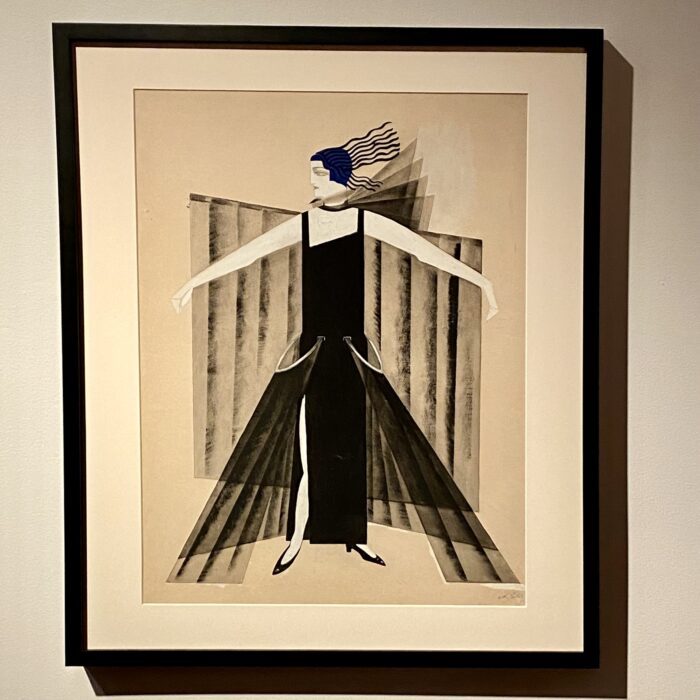
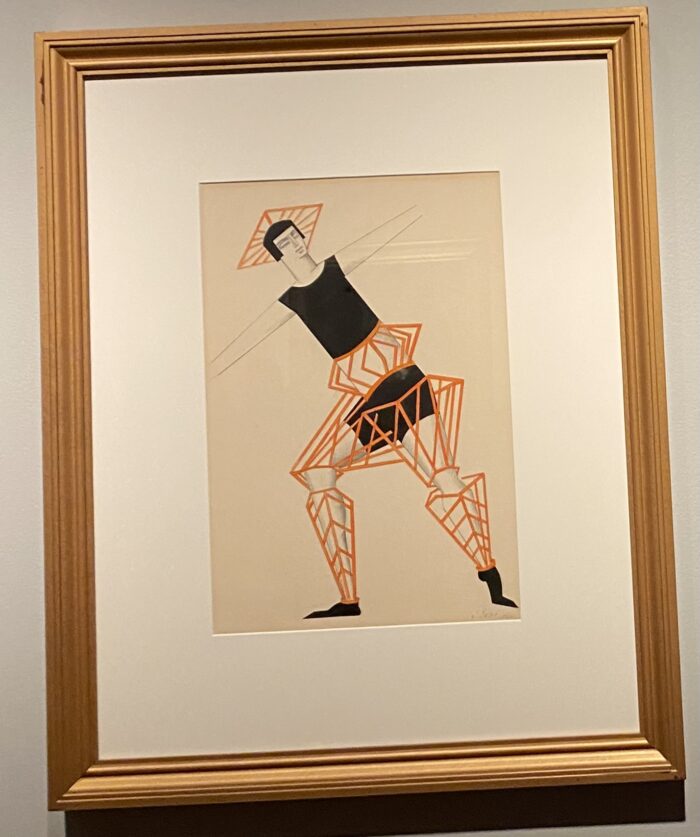
Exter frequently pushed the boundaries of her art, relishing the opportunity to experiment. The costumes she designed for Aelita distinguished themselves due to her use of unconventional materials that had not been incorporated into costume design before (Doroshenko). Exter gave the Martians a more gender-neutral appearance than was common in Soviet society; the Martian men wear decorative dresses, and the queen displays a unibrow. The Constructivists’ utopian vision also included increased gender-neutrality. They believed that achieving this utopia necessitated the use of perfectly straight lines and geometric shapes. Exter did not share these beliefs. Fashion scholar Dr. Djurdja Bartlett explains the Constructivists’ reasoning, “The fact that the grid does not imitate the existing world and that it is instead the outcome of an aesthetic decree allows for its messianic role in the arts and society” (272). Though Exter did not exclusively use straight lines and geometric shapes when designing the Martians’ clothing, they do feature prominently. However, the use of straight lines, gender-neutrality, and geometric forms does not lead the Martians to experience utopia.
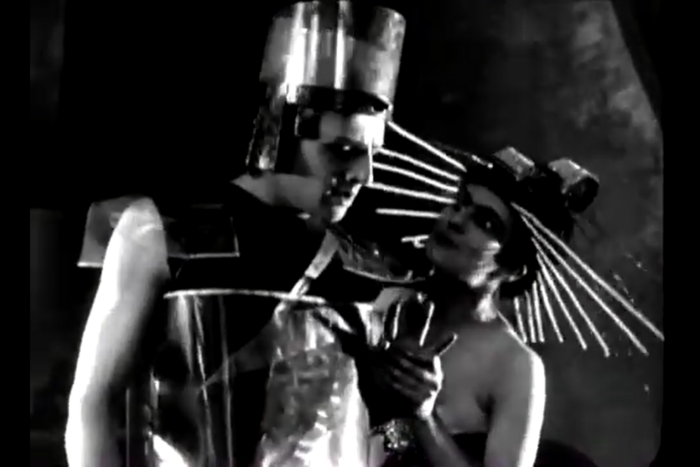
The Martians in the film symbolize the Russian monarchy, which the revolution overthrew. By incorporating common Constructivist motifs, Exter proves their ability to evoke a sense of otherworldliness. However, she also shows that the designs fall short of inspiring societal betterment and a utopia. Although the Constructivists would never design anything like the Martians wore because they “fiercely rejected any form of decoration” (Bartlett 271), Exter’s successful use of Constructivist elements for the Martians’ monarchy illuminates the failure of the Constructivists to connect aesthetics with moral identity.
The Constructivists’ experiment with fashion failed. Bartlett says, “The Soviet designers did not invent a new dress and eventually abandoned their utopian dream altogether” (276). Although the Constructivists did not invent a new dress, Exter did. Their experiment shows that if fashion can create a utopia, it must connect to people’s moral identity, in addition to transforming how they see and communicate with the world.
The Ukrainian Museum has an excellent exhibit on Alexandra Exter, open now through 19 January 2025, if you want to learn more about this accomplished and fearless artist.
Aelita was produced by the production company Mezrabpon-Rus, owned by Farncesco Misiano, an Italian who found a home in Soviet Russia after fleeing Fascist Italy. The book Francesco Misiano Cinema and Revolution. Literary Works and Celluloid Adventures, edited by Eugenio Attanasio (Trans. Demetrio Iannone), documents his harrowing life story and the impact he had on the world with his films. If you get the book, be sure to check out the essay by Professor Eugenia Paulicelli, “The Art and Craft of Costume Design: Alexandra Exter’s Work for Aelita: Queens of Mars.” You can also find Professor Paulicelli and Demetrio Iannone discussing this and similar topics on CUNY TV.
http://CUNY TV Presents: Films – CUNY TV
For more information and to keep in touch, follow our Instagram: https://www.instagram.com/thefabricofcultures/p/DCIHxM_h1Qp/?img_index=1
Finally, if you are interested in watching Aelita, you can find the entire film on YouTube:
Bibliography
Bartlett, Djurdja. “The Socialist Sartorial Utopia: Then and Now.” The Brown Journal of World Affairs, vol. 23, no. 2, 2017, pp. 269–85. JSTOR, https://www.jstor.org/stable/27119070. Accessed 14 Nov. 2024.
Doroshenko, Peter. “The Stage is a World.” Tour. 6 November 2024. The Ukranian Museum. New York, New York.
Paulicelli, Eugenia. “The Art and Craft of Costume Design: Alexandra Exter’s Work for Aelita: Queens of Mars.” Francesco Misiano Cinema and Revolution. Literary Works and Celluloid Adventures, edited by Eugenio Attanasio, translated by Demetrio Iannone.

