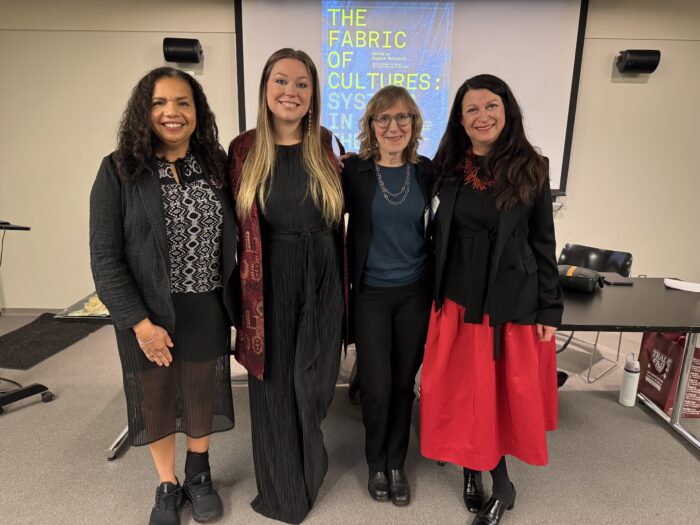
The Fabric of Cultures team had the honor of presenting at CUNY’s second Teaching and Learning Conference, held the first week of April. According to their website, the conference “is a celebration of teaching excellence and a commitment to creating a thriving academic community.[i]” Our group included Prof. Eugenia Paulicelli, the founder and Director; Iris Finkel, Associate Director and Website Manager; Marissa Guijarro, a student in the Fashion Studies program; and I, Sarah Porterfield, also a student and the Social Media and Blog Editor.
Our presentation, “Threads and Theories: Using Public Platforms to Foster Interdisciplinary Teaching, Learning and Research,” focused on our use of the public platform Omeka as a teaching and learning tool. Omeka is an exhibit and archive-building platform. The idea of using Omeka in Professor Paulicelli’s courses originated with Iris, a former student of Professor Paulicelli. She created an Omeka exhibit while taking one of Professor Paulicelli’s courses. Subsequently, Professor Paulicelli incorporated Omeka into her curriculum, and Iris returned to Paulicelli’s classroom to teach new students, like Marissa and me, how to use Omeka.
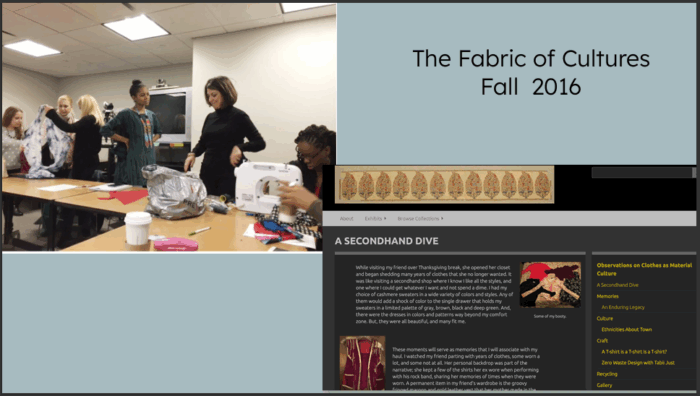
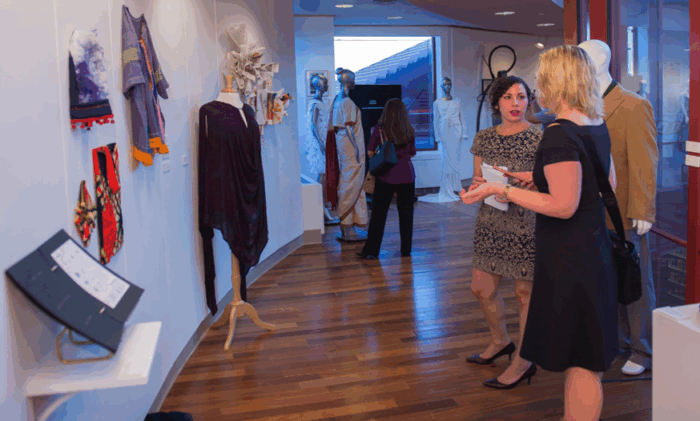
Professor Paulicelli began our presentation by sharing the history of how she created the fashion studies MALS track at the Graduate Center and The Fabric of Cultures. She showed photos of exhibits she had organized with her students, as well as catalogues she co-edited, which display the work of her students. She showed fashion apparel being constructed in her classrooms. Then she showcased the work of recent students who combined fashion design with technology, displaying their constructions using Omeka. Creation, exhibits, and displays have been a throughline of Paulicelli’s dynamic teaching.
Next, Iris shared her experience in Professor Paulicelli’s courses. She recalled constructing a zero-waste garment and felt inspired to create an Omeka site to track her learning and interests. Then, she discussed her experience teaching students to share projects on Omeka, which led Marissa and me to explain Omeka from a student’s perspective. We provided quick overviews of our sites and highlighted key takeaways. Marissa elaborated on how the interdisciplinary nature of fashion studies aligns well with Omeka, which enables the sharing of various types of media. She also mentioned that Omeka makes education accessible, ensuring that what we learn does not remain confined to the “ivory towers”—two crucial points about Omeka.
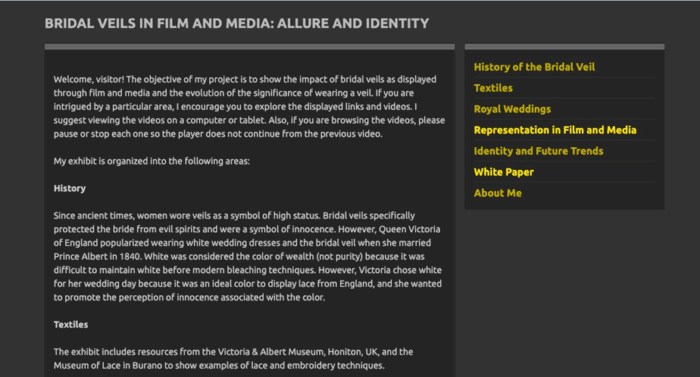
As I consider the use of Omeka as a teaching and learning tool, I am impressed by how the two elements come together in Omeka and The Fabric of Cultures; as students learn, they teach. The publication of this blog reflects the same idea: as I learn, I add to my education by sharing it. The Fabric of Cultures site, similar to Marissa’s observation about Omeka, makes valuable educational materials accessible and provides insight into the interdisciplinary nature of fashion studies. It serves as a platform for both teaching and learning. A theme of Paulicelli’s courses is elevating students to become teachers, authors, and artists, thereby disrupting the hierarchical order that separates teachers from students. Thus, teaching and learning overlap and intertwine. Omeka (and The Fabric of Cultures) infuses creativity into academia, inspiring teachers and learners to push boundaries. Omeka, The Fabric of Cultures, and our small team all participate in expansive teaching and learning.
[i] https://www.cuny.edu/academics/faculty-affairs/cuny-innovative-teaching-academy/cuny-teaching-and-learning-conference/2025-cuny-teaching-and-learning-conference/

