
Sylvia in the Fountain: Creating The Look
In the 1950s and early 1960s, there were different what’s-appropriates for different bodies. The impact of, say, an androgyne like Audrey Hepburn in an evening dress would have been quite different from the blonde and dangerous bodies featured in this exhibit. The voluptuousness of Sylvia in La Dolce Vita, as portrayed by Swedish actress Anita Ekberg, for example, made her automatically subject to additional scrutiny. It would already have been considered rude and disruptive to bathe in an 18th-century Roman fountain, and additionally inappropriate—and certainly impractical—to wear a velvet evening gown while doing so.
But if women are historically and culturally associated with the body—with emotions and feeling and a kind of animal wildness—a hyper-sexual body carries those qualities multiplied. This means the spectacle of Sylvia in the fountain, spilling over the dress, is even more inappropriate.
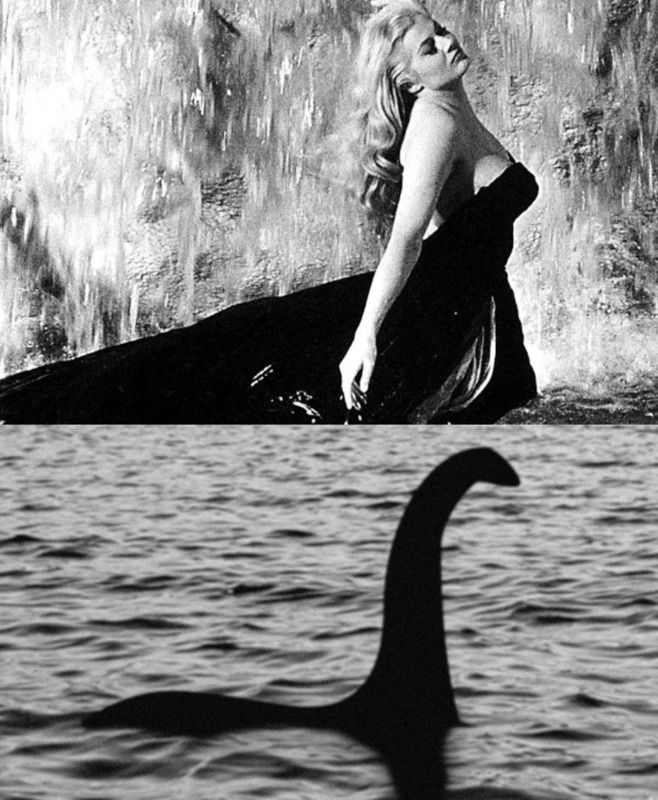
And powerful.
It begins with her delight in seeing the fountain, as she holds up the train of her dress to protect it from getting wet, and then just as soon lets it go, as a silken monster. The sensual pleasure conveyed in the close-up as she stands under the fountain is innocent, palpable, almost sacred—even Marcello cannot touch her, his hands tracing the space between her face and throat as if there is an invisible boundary around her body. The wet dress clinging close as if it is no longer material, not other, but absorbed, transmuted by the body into a second skin.
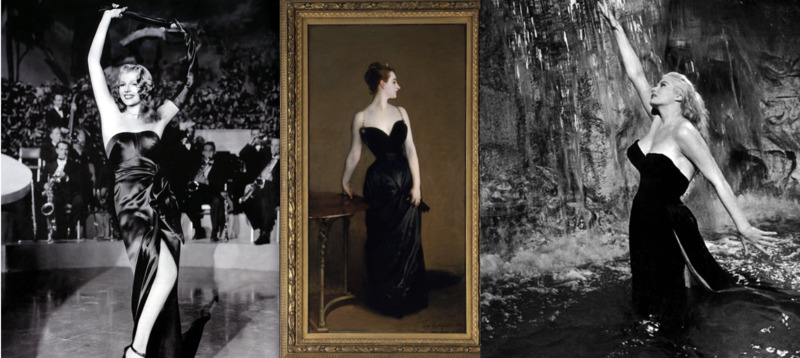
Created by Italian fashion and costume designer Fernanda Gattinoni, the strapless dress with sweetheart bodice and gossamer-like underlayers was said to have been inspired by the black satin sheath dress worn by Rita Hayworth in 1946’s Gilda—which in turn paid homage to John Singer Sargent’s 1884 “Portrait of Madame X.” While Gilda wore the dress to perform in a nightclub, and the socialite Madame X was dressed for a portrait, what makes Sylvia’s version of the black dress different is its deliciously inappropriate context.


“Have you ever felt like a myth?” Susana Gimenez asks.
“I don’t care about it. It’s not important,” says Ekberg. “But I am a woman who likes to live, dance, go barefoot…”
P.S. Be sure to listen for the inspiration behind the iconic scene. (Hint: It was not her first bath in the Trevi Fountain.)