
Browse Exhibits (11 total)
Film Autobiography - Dior and I (2014)
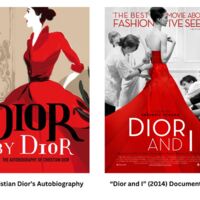
Fashion documentaries reveal many angles of the fashion industry, from the birth of ideas to the process of designing and manufacturing clothes.
Considered among the top biographical fashion films, Dior and I (2014) captures the complexity of creating a haute couture collection from the standpoint of the head designer. It follows the creative process of two fashion designers, the late Christian Dior, the founder of the House of Dior, and Raf Simons, the appointed creative director for Dior from 2012 to 2015. The similarity between the two designers’ visions and personalities was highlighted by the interchanging autobiographical voice, combining two storytellers from different eras.
The film reveals the complexity and different layers of identities of fashion designers. Starting from Dior’s memoir, where he opens up about his conflict between his public and private image, the film continues by unfolding the different characters in play in Raf Simons’s identity, having to deal with his private versus public identity like Dior but also to cope with the third entity - Dior’s legacy - the pressure of having to perform at the level of Dior’s caliber.
Written by: Eddy Berzak
Sports Jerseys: Fandom, Politics and Fashion
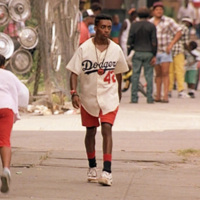
Since the early 1990s, it’s been nearly as likely to see someone decked out in a sports jersey in a music video as it is inside Madison Square Garden. What was once just a functional uniform for athletes, the sports jersey evolved into a signal of hardcore fandom only to be further transformed into a streetwear staple that transcends geographical boundaries and local allegiances. Jerseys are a style choice, an identity marker and often, a political statement. Wearing a Colin Kaepernick jersey after 2016 is more a declaration of your stance on racial justice than it is a nod to his career as a 49er.
This exhibit will track the evolution of sports jerseys from a simple expression of fandom to both a coveted fashion staple and sartorial declaration of social and political allegiances. The accompanying white paper and images will explore:
- how sports jerseys reached the mass retail market in the 1970s and how subsequent mass marketing of jerseys in the 1980s furthered their popularity
- how rappers’ adoption of jerseys as wardrobe cemented them as a major component of hip hop style in the 1990s
- how (in the case of N.W.A) a team’s jersey and logo became synonymous with identity and a target for racism and bias
- why many traditional fashion brands in the 1990s (Ralph Lauren, Tommy Hilfiger) chose to incorporate branded sports jerseys into their collections while many streetwear brands centered their collections around jerseys (Sean John, FUBU, Enyce, Phat Farm)
- how sports jerseys are used as a tool of characterization in both film and television
The exhibit will track the sports jersey’s position in fashion to the present day and will examine the political connotations of some modern jerseys, the growing popularity of the jerseys of women athletes and how jerseys are currently used in high fashion.
The images in this exhibit are sourced from music videos, television and film, advertisements, museum collections and paparazzi photographs. The temporality of the images ranges from the early 1970s, when Mary Tyler Moore wore a Minnesota Vikings jersey in the opening credits of the Mary Tyler Moore Show through 2023 when Beyoncè and her daughter Blue Ivy wore matching Ivy Park jerseys during a Renaissance Tour stop.
The Best Little Warehouse in Hollywood... And 49 Other States!
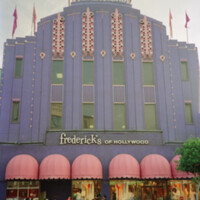
This site explores the brick-and-mortar stores of the iconic lingerie retailer, Frederick's of Hollywood, from the heyday to the mass closures of the 2010s.
Before I chose Frederick's as my site of study, I had questions that came from my own work experiences. From working at a dry cleaner as a teenager, to vintage shops in college, to a punk fashion boutique now, for years I have witnessed and wondered how gender and sexuality takes shape in clothing shops. In the essay that follows this exhibit, I call this process brick-and-mortar erotics, which I define as the ways that the workers, consumers, and other visitors of an in-store retail environment can find their genders and sexuality affected as they interact with each other and the products for sale.
The following questions guide my research: How does a piece of clothing transform when it is placed on display in a storefront window, hung on a shop's rack, or tried on in a fitting room? What are the erotic qualities of retail consumption? For customers? For workers? How is gender constructed in a clothing store?
I look to Frederick's of Hollywood to help me answer these questions for two reasons: 1.) because if brick-and-mortar erotics is present in clothing stores in general, then it is heightened in lingerie shops, where sex is front and center, and 2.) because the brand experienced a major shift when it closed all in-person stores, and to me, an exploration of what was lost (or in other words, what happened in these stores before they closed, that is no longer happening) is worth conducting.
The purpose of this site is to share images and videos of various Frederick's locations, from the first storefront on Hollywood Boulevard to malls across America.
The first page, Hollywood Boulevard, uses the first Frederick's store as a starting point to describe the early history of Frederick Mellinger and his brand. The second page, Filming Frederick's, shares YouTube videos of both television news segments and promotional videos that show what it was like to work and shop at Frederick's stores over the years. The third page, Customers with Cameras, takes pictures from customers' Yelp reviews of several Frederick's locations nationwide. Following these pages, I share my essay that theorizes gender, sexuality, and in-store shopping.