
The Birth of the Retail Jersey, 1960s-1980s
Retrospectives on the rise of the sports jersey as a mainstream wardrobe staple for non athletes are conflicted about the origins of the “retail” sports jersey and at what point it saturated the stands of sporting events worldwide. Yet, there is one thing that these retrospectives do agree on: that there is no clear reason as to why sports jerseys became a phenomenon amongst fans in the second half of the 20th century, other than an increase in their availability.
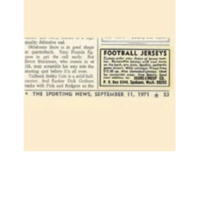
This rise in availability of jerseys to retail customers began in the 1960’s and 1970’s a number of regional sporting goods suppliers across America made sports jerseys readily available to eager consumers by creating and selling replicas of professional sports jerseys- without the licensing rights from professional sports leagues.
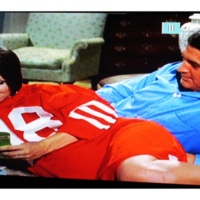
The images in this section show early examples of celebrities and on screen characters wearing sports jerseys alongside early examples of retail jerseys.
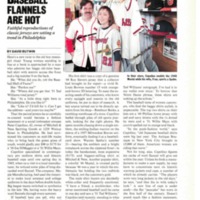


The Philadelphia sporting goods store Mitchell & Ness is arguably the most infamous and enduring manufacturer of replica sports jerseys. Started in 1904 as a golf goods dealer, Mitchell & Ness began supplying athletic jerseys to Philadelphia sports teams like the Phillies and the Eagles in the 1930s. Over the next 50 years, major league sports teams began contracting with larger sporting goods stores to make their uniforms, leaving independent manufacturers like Mitchell & Ness financially destitute. In 1985, Mitchell & Ness’ owner Peter Capolino agreed to mend two vintage baseball jerseys for a customer using discarded wool from a nearby manufacturer. Pleased with the outcome of these two restored jerseys, Capolino began incorporating vintage baseball jerseys into M & N’s product line. Capolino’s innovation, paired with his desperation to save his business, created a whole new category of retail athletic wear- one that would forever change how consumers incorporated sports jerseys into their everyday wardrobe.