
David Byrne's American Utopia
In 2018, David Byrne toured for his album American Utopia, a name that is not indicative of how he views America but rather how he hopes America can be. Incidentally, it was during this tour and its transfer to Broadway in 2019 that Byrne finally achieved his goal of creating a unified collective onstage. Pairing a uniform dress style with professional choreography, Byrne connected his bandmates in a way that he had been unable to up to this point. The band wore grey tailored suits and no shoes, the great equalizers in Byrne's estimation. He views suits as a way to anonymize himself and his band, just as businessmen use their suits as a way to pass without recognition in every city. When you are in a suit, you are just another person in a suit. Byrne also believes that everyone looks good in a tailored suit, regardless of body type or gender, so choosing a suit as the costume allowed him to avoid the foibles he faced during his 2001 tour. The lack of shoes also allowed for further connection, as the band may have chosen different shoes from one another if they were going to wear them, which would be a way to separate the collective in a simple way.
In American Utopia, Byrne is not only concerned with creating a collective onstage but also with what it means for humans to create connections among themselves in everyday life. Throughout the show, he ponders how one can create a connection with others and what steps we can take to learn about those other than ourselves. While America is often viewed as an individualistic society, Byrne's American Utopia envisions an America that is concerned not with each individual self but with all people, all Americans, and their wellbeing.
While Byrne discusses his own challenges with making connections and the steps he's taken to overcome them, including watching TV, the audience is able to watch him connect with his band on stage. He has perhaps not fully faded into the background, as he may wish to do, but his band is nearly as prominent as he is as they join him on the stage. In their grey suits, without their shoes, the band fades into each other as they move around the stage, establishing and showing the audience the connections between themselves.
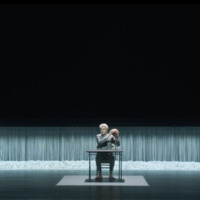
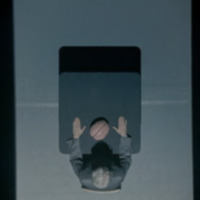

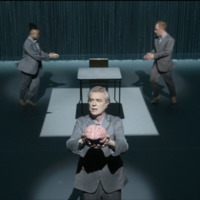
Interestingly, American Utopia, begins largely the same way as Stop Making Sense does, with Byrne alone on stage. He is sitting at a table and has a model of a brain with him. As he sings about the funny way the brain works, he is joined by two dancers. As the show progresses, more people join the stage until there are eleven people, some with instruments and some without, populating the stage together.
They share a common dress and wear no shoes, connecting them to each other and the stage simultaneously. Byrne continues to sing about connections, no longer those in the brain but now the ones that run between all people. He describes how he found it hard to find his place in the world, particularly among other people and how he has attempted to find that place over the years.
Like Stop Making Sense tells the story of Talking Heads, American Utopia tells the story of Byrne. His lifelong search for community is detailed through the songs, his story, and the choreography, and the audience watches as he finally gains that community. By the end of the show, Byrne has finally found his place, within the collective he’s formed on stage with the other musicians, of varying ages, races, and genders and yet all as one.
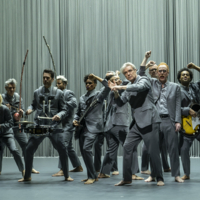
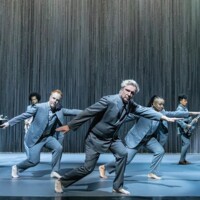
American Utopia was fully choreographed by Annie-B Parson. Parson’s choreography uses elements of everyday movement to create something that is both accessible to an audience and to dancers who are not trained as such, making her an ideal collaborator for a musician such as Byrne. She took movements he already did and put them not only into his choreography but into the choreography for the whole band, allowing them to form a collective thorough movement.