
Stop Making Sense


In 1983, Talking Heads toured with an extended lineup, growing from the foursome they had become during their later period at CBGB into a nine-piece band, as was necessary to accommodate the more complex sound they were producing at the time. During this tour, Byrne first attempted to show his band as a collective rather than a group of individuals. He told the band to dress in all neutrals for the tour so that, from the audience, they would not be easily distinguishable from each other. In some images from Stop Making Sense, the concert film that was produced during this tour, Byrne's vision seems to be realized.
However, in other images, this dream is not seen, as the band did not clearly follow Byrne's instructions to dress neutrally. While the additional members dressed in greys and browns, Frantz and Weymouth both undermined Byrne's vision through some of the outfits they wore in the film. Since the film was actually three separate days of concerts, both Frantz and Weymouth sometimes are dressed neutrally but, during other sections, are dressed in ways that separate them from the band at large.
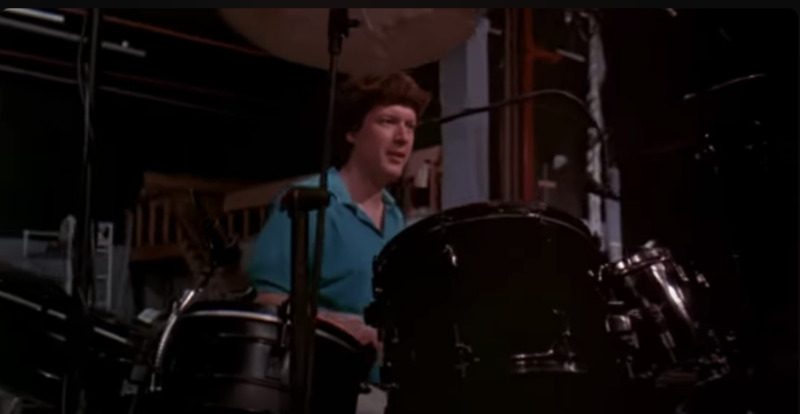
Despite Byrne telling the band to dress in neutral clothing, Frantz, the drummer, begins his time in the film as the band plays "Thank You for Sending Me an Angel" in a turquoise shirt. Rather than blending into the group from the drum stand, Frantz stands out in every frame that he is in. No matter who is doing the main action during the film, Frantz draws the audience's eyes in the moments when he is in his turquoise polo.
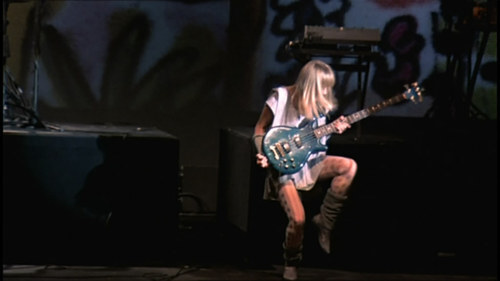
Frantz wore a brown polo for part of the filming and blended into the collective group when he had it on. However, Weymouth, the bassist, has her own moment of disconnect from the rest of the group. Unlike Frantz, she wears neutrals throughout the film, but she fails to wear clothing that is timeless. While the rest of the band dresses in a way that could be 1983 or 2023, Weymouth wears an outfit that is distinctly 1980s in a portion of the film. While she is initially dressed in grey loungewear, for the later part of the film, Weymouth wears leg warmers, pattern tights, and a dress with a ragged triangle cut. This outfit makes her stand out, despite being grey, because it firmly places her in the time that the film was made, while everyone else is dressed in a way that is not particularly tied to the 1980s. She leaves whatever collective has been established at this point.

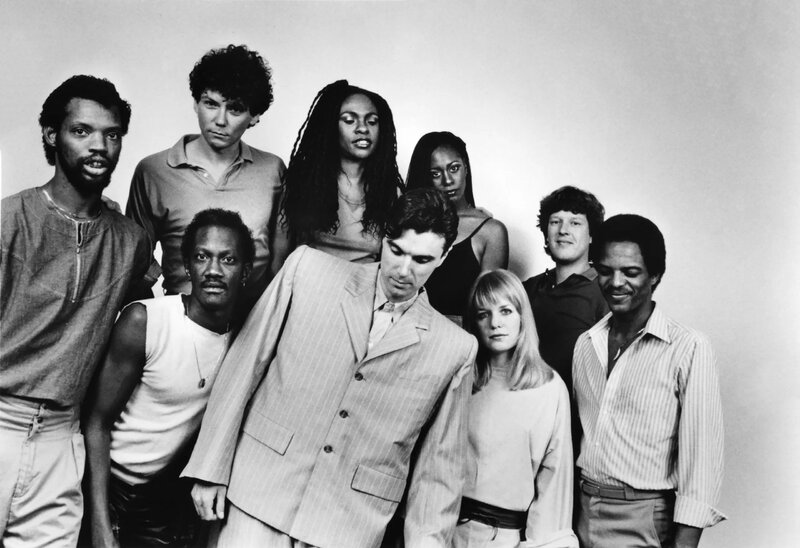
Byrne also undermined his vision of collectiveness during Stop Making Sense as he envisioned himself in a large suit while in Japan during the band's previous tour. In Japan, he spoke with a friend who told him that performances in Japanese theater were always bigger. While the friend meant bigger theatrically, Byrne took the suggestion seriously and began envisioning ways to make himself bigger on stage. In his literal interpretation, Byrne decided that wearing a big suit would allow his body to appear bigger than it was, which would give his audience the effect of seeing a performer who was larger than life.
He sketched out his idea on a piece of notebook paper and set forth engineering it for the next tour. While the suit was built by a designer, Byrne designed it himself so that it looked flat from the sides and big from the front, as though he was the embodiment of a playing card. The comically large, grey suit distinguishes Byrne from his bandmates and makes it clear that he is the leader of the group rather than a member of the collective. While his bandmates' clothing choices already undermined his vision, his big suit would have ultimately prevented the band from appearing as a collective even if Frantz and Weymouth had not made their own poor fashion choices.
Byrne has described the "narrative" of Stop Making Sense as a singlular man who is lonely and disconnected and eventually finds a group he can call a family. This narrative is established both by the structure of the band through the film, as Byrne begins the concert alone on stage and is slowly joined by the rest of the band, one by one, and also through the band's similar dress, despite the times that this concept is undermined. This concept is also aided by the use of choreography in the film.
Byrne devised the choreography for Stop Making Sense largely on his own. He did movements that felt natural to him and had the other band members, in particular Holt and Mabry, but occasionally Weymouth, Weir, Harrison, and Scales, as well, join in during specific moments. The planned dances allowed the audience to see the group not only dressed similarly but also, at times, moving similarly. Like many elements of the film, the choreography sometimes falls flat as a connector, largely because Byrne had come up with it on his own and asked the others to join in only when they felt comfortable. Therefore, there are many moments where Byrne is clearly the front man as he dances, drawing all of the attention to himself and away from any collective that has formed.