
Representation in Film and Media
An important precursor to subsequent depictions of veils in cinema is the film, Satanic Rhapsody (La Rapsodia Satanica) directed by Nino Oxilio in 1915. The protagonist, Alba, articulates her desire and vulnerability through the undulations of her veil. She is a bride, but one who is doomed to loneliness. Her dance of unfulfilled passion and the bridal procession exist as juxtapositions in the manifestation of identity and collective memory through the veil.
Beginning in 1949, the bride became the star protagonist starting with a series of media events and films with the wedding of Linda Christian and Tyrone Power in Rome.
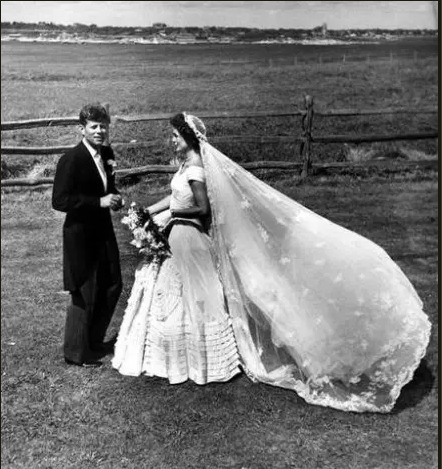
Jacqueline Bouvier Kennedy’s dress and veil made an indelible imprint on bridalwear. She wore her grandmother’s cathedral-length veil (the “Lee Veil”).
Jacqueline Bouvier Kennedy
In Funny Face (1957), Audrey Hepburn mesmerized audiences as her character played a model in a Givenchy-designed bridal costume. The ballerina-inspired tea-length dress introduced a new silhouette with a full tulle skirt and a fingertip veil.
In the 1965 blockbuster, The Sound of Music, Julia Andrews as Maria wears a cathedral-length gown and veil reminiscent of the Grace Kelly silhouette and headpiece, designed by Dorothy Jeakins
In 1972, The Godfather opens with Connie's lavish Long Island wedding. Her dress and veil are harbingers to the voluminous bridal fashion to come in the 1980s and reflect her socioeconomic status as the daughter of Don Corleone. Apollonia and Michael Corleone are married in a traditional small-town wedding in Sicily. Apolloinia's wedding ensemble is faithful to her origin.